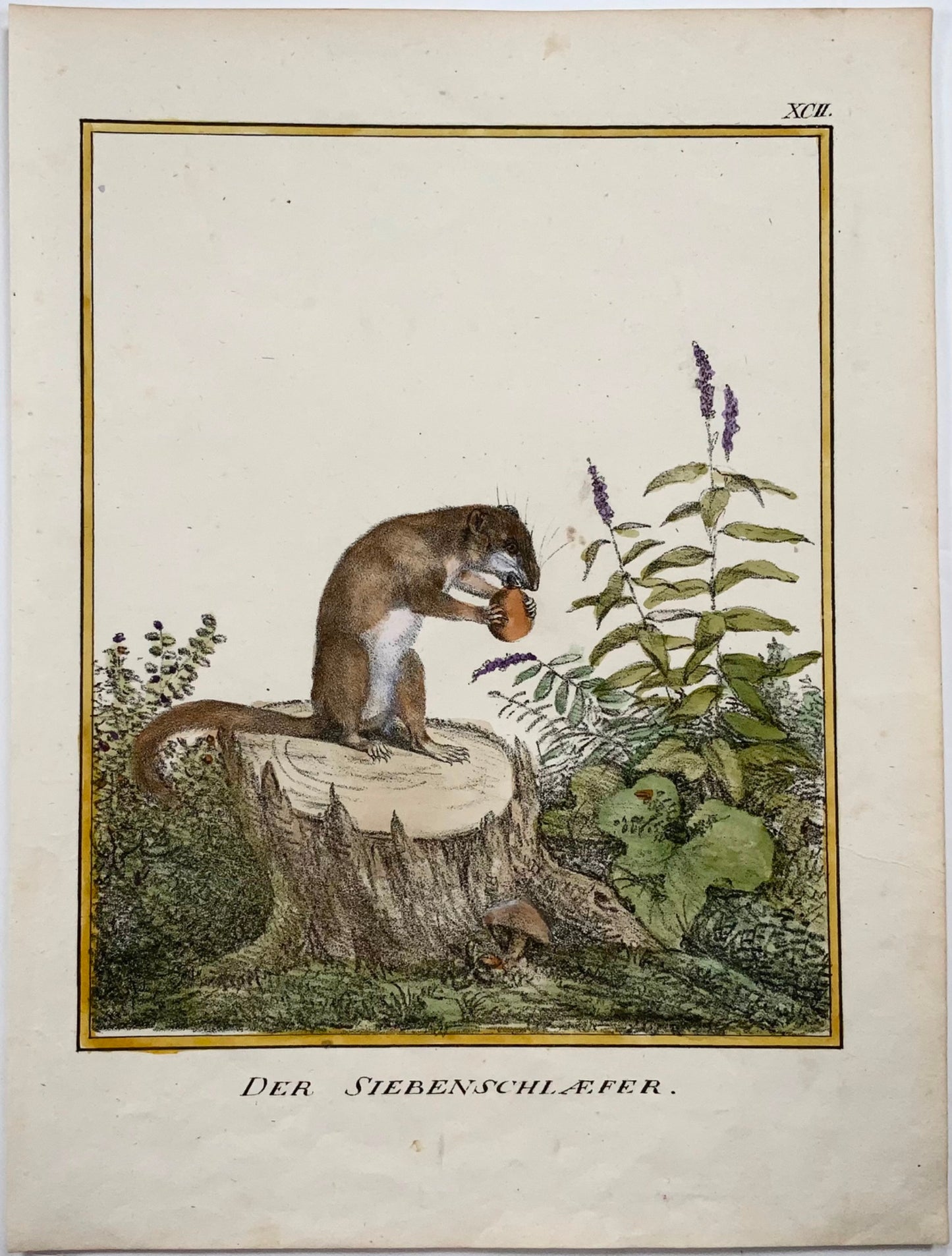
1816 Dormouse, K. Schmidt 4to hand coloured, mammal, incunabula of lithography
1816 Dormouse, K. Schmidt 4to hand coloured, mammal, incunabula of lithography
Impossibile caricare la disponibilità di ritiro
Extremely rare quarto crayon lithograph marking a landmark in the development of zoological book illustration.
Karl Schmid
Quarto Crayon Lithograph with hand colour.
24.3 x 18.3 cm
Published in Munich, 1818.
Extremely rare!
Stone lithography was invented in 1796 by German author and actor Alois Senefelder as a cheap method of publishing theatrical works. In the early days of lithography, a smooth piece of limestone was used (hence the name "lithography": "lithos" (?????) is the ancient Greek word for stone). After the oil-based image was put on the surface, a solution of gum arabic in water was applied, the gum sticking only to the non-oily surface. During printing, water adhered to the gum arabic surfaces and was repelled by the oily parts, while the oily ink used for printing did the opposite. Germany was the main center of production in this period. Godefroy Engelmann, who moved his press from Mulhouse to Paris in 1816, largely succeeded in resolving the technical problems, and during the 1820s lithography was adopted by artists such as Delacroix and Géricault.